
Proposed stablecoin rules might guarantee your dollar while making you wait a week to spend it
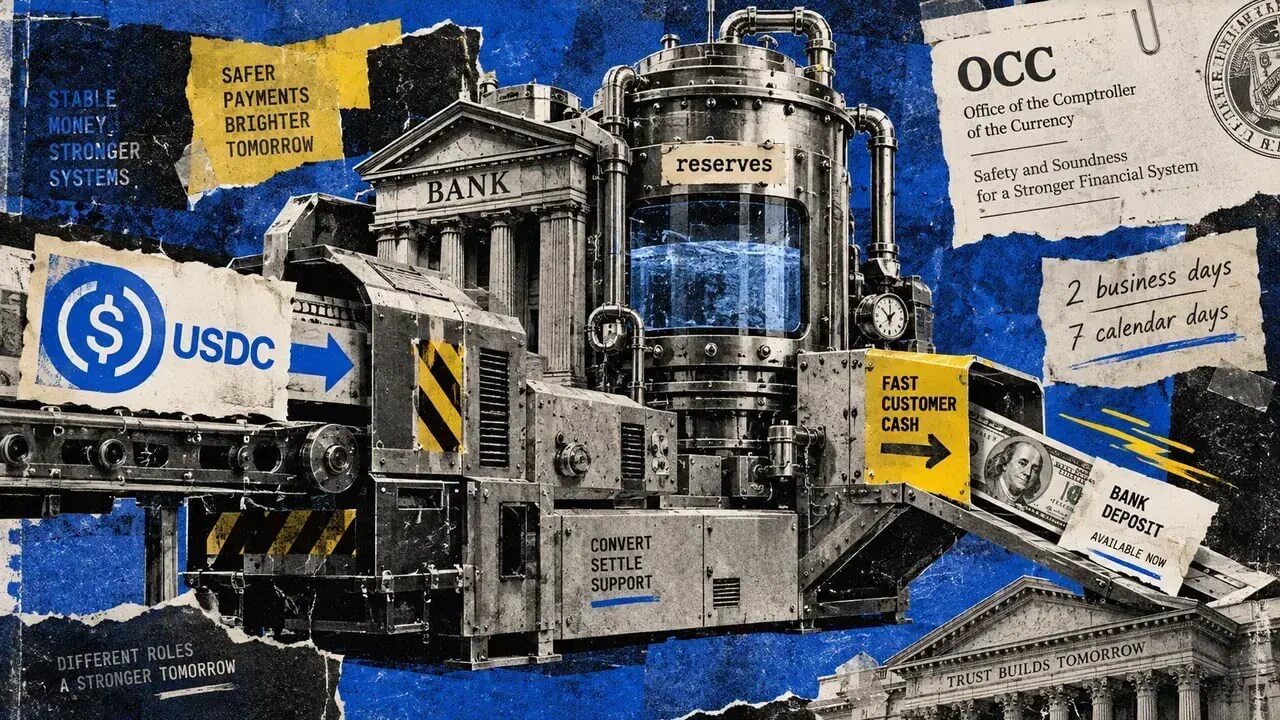
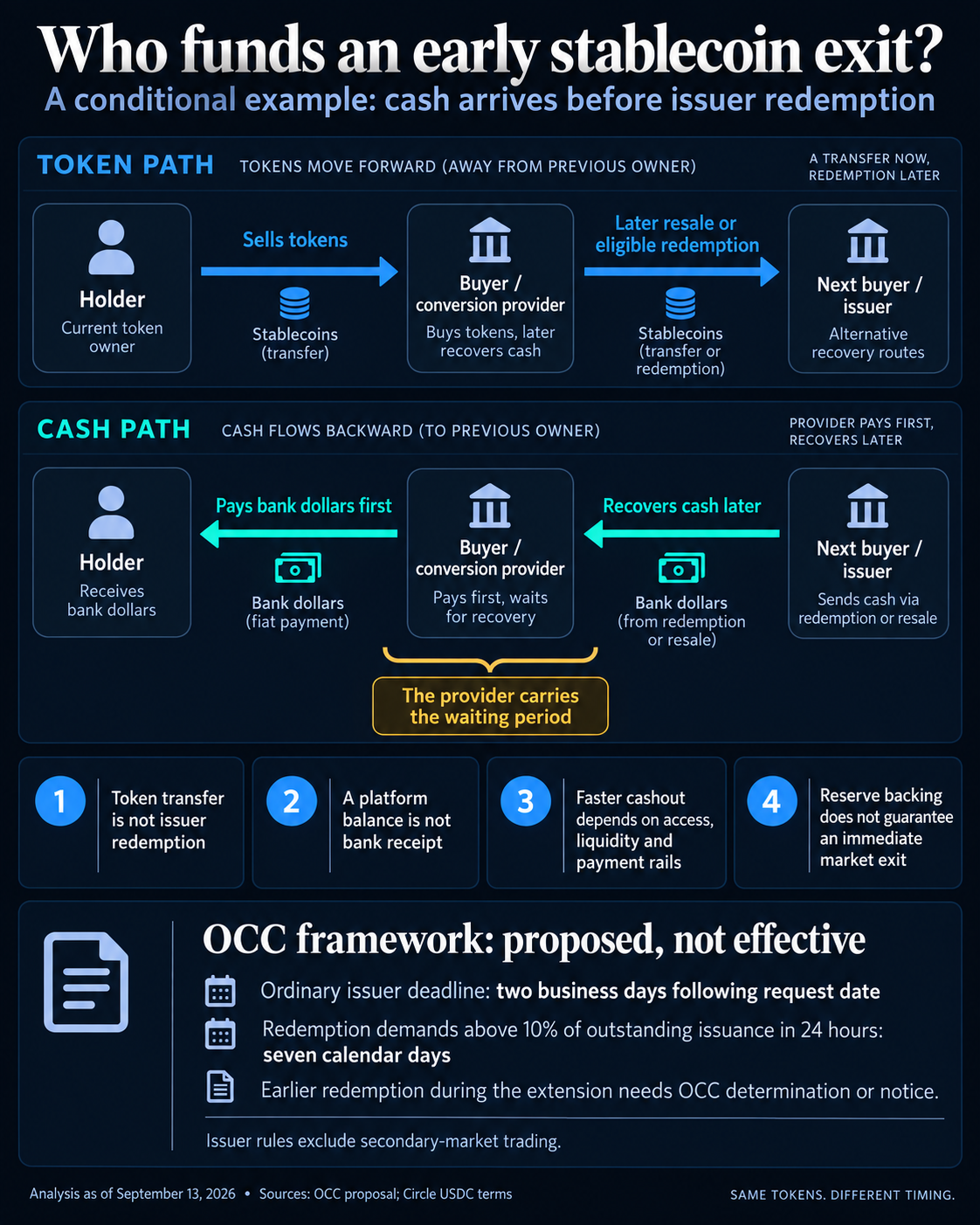
When a stablecoin holder receives spendable bank dollars before the issuer redeems the token, a buyer or conversion provider has funded the early exit. If that party keeps the token, it must wait until resale or redemption to get its cash back.
The Office of the Comptroller of the Currency’s proposed redemption framework could give an issuer time to sell reserves in an orderly way while allowing secondary-market trading to continue.
A Sept. 4 Federal Reserve staff analysis clarifies the issue by separating round-the-clock blockchain payment functionality from conversion into bank dollars. Its authors describe redemption timeframes as unsettled.
The practical question for households and businesses is what happens between transferring a token and receiving money they can spend through their bank.
A longer redemption window leaves trading open
The OCC’s proposed section 15.12 would set an ordinary redemption deadline of two business days following the request date, keeping faster redemption possible.
However, demands exceeding 10% of outstanding issuance value in one 24-hour period would automatically extend the period to seven calendar days for outstanding and subsequent requests.
During that extension, earlier redemption would require an OCC determination that it could proceed in an orderly, fair and transparent way, or notice that the extension no longer applied. The OCC could also extend the period for specified safety, stability or public-interest reasons.
The agency says the provisions cover issuer redemption, including entities acting on an issuer’s behalf, but exclude secondary-market trading. The proposal applies to entities within OCC jurisdiction, and its stated rationale is orderly reserve liquidation with less price disruption from sudden sales.
As of Sept. 13, the measure remained on the OCC’s proposed-issuance list, with a March 2 opening and a May 1 comment deadline. No corresponding rule appeared on its 2026 final-issuance list.
For a holder selling before issuer redemption, the immediate source of cash is the buyer or service completing the conversion. The issuer’s reserves remain separate from the transaction chain, so a sale changes who holds the token.
If a provider uses available dollars to pay a departing holder and retains the acquired tokens, it has exchanged cash for an asset it must either hold, resell, or redeem. If it resells to another willing buyer, the exposure moves again. If it waits for issuer redemption, its cash remains committed through that interval.
This is why an issuer delay need not translate into an equally long customer delay. A provider with available cash and willing counterparties could continue offering conversion. For the customer, the bridge may be almost invisible: the token leaves, and the bank payment arrives before the issuer pays the provider.
A longer interval could require more funding for the same pace of payouts, or reduce a provider’s willingness to hold additional tokens, and quotes and fees could respond.
That mechanism explains where the waiting exposure goes when an earlier exit succeeds.
A redemption right still needs an access route
Circle’s USDC terms for holders outside the European Economic Area distinguish token ownership from direct redemption access. The terms require an eligible Circle Mint account in good standing. A holder receiving USDC acquires a conditional redemption right, but holding the token alone does not make that direct route immediately available.
The same terms commit to one dollar per USDC on redemption, subject to the terms, applicable law, and fees. They do not guarantee that third-party platforms will quote USDC at one dollar.
An issuer’s contractual conversion value and a buyer’s executable price answer different questions.
For a holder using a platform, the relevant sequence includes access to that platform, a conversion at the available price, and a final payment into the bank account. Success at one step does not establish the timing of the next. A completed token trade can leave the customer with a platform balance while the cashout process is still under way.
These particular Circle terms expressly exclude EEA holders, and they support an analysis of the specified non-EEA route.
Existing service descriptions give reasons an issuer’s ordinary processing interval may not dictate a customer’s experience.
Circle’s 2025 Form 10-K described institutional onboarding and two redemption options: basic redemption initiated within two business days and standard redemption initiated nearly instantly. It also described banking infrastructure with multiple rails, including round-the-clock funds-flow capabilities where available.
Coinbase’s instant-cashout guidance describes US customers withdrawing from US dollars or USDC balances to eligible US bank accounts connected to Real Time Payments. It specifies a $100,000 limit per transaction for instant bank cashouts and requires an eligible, verified payment method.
Its general guidance says instant cashouts typically take around 30 minutes but can take up to 24 hours depending on the bank or card provider. That broader timing guidance should not be read as a separate guaranteed delivery time for every RTP transaction.
These routes weaken any blanket claim that stablecoin holders must always wait for an issuer’s full redemption window. They also make the limits concrete: eligibility, transaction size, and payment arrangements matter. A documented service can provide a usable exit without establishing unlimited capacity during a surge in demand.
Stablecoin reserve liquidity and market liquidity do different jobs
The proposal also contemplates qualifying Treasury-bill repo borrowing to support redemptions. That provides a potential source of issuer liquidity alongside liquid reserves, while permission to borrow does not establish an actual counterparty commitment, nor does a funding mechanism by itself remove the proposed conditions for redeeming early during the seven-day extension.
Circle’s terms say that affiliate trading activity supporting USDC is optional and may stop. That qualification concerns those activities, and leaves a meaningful difference between a functioning secondary market and an obligation to keep buying tokens under all conditions.
For a business that needs bank money before an issuer pays, the useful distinction is whether its conversion route has both an executable price and a payment arrangement that meets its deadline. Reserve backing alone cannot answer that operational question, nor can the speed at which the token changes blockchain addresses.
The Fed staff note offers a reason to keep these functions separate: transferring value and converting it into dollars can follow different timelines.
As the OCC framework develops, the terms of any final redemption extension will determine the issuer’s permitted timetable. An earlier customer exit will depend on a provider’s willingness, available liquidity, eligibility rules, and payment settlement.
When that bridge works, the holder exits and another party carries the interval. When it is unavailable, sound backing alone does not bring the bank payment forward.
The post Proposed stablecoin rules might guarantee your dollar while making you wait a week to spend it appeared first on CryptoSlate.