
Crypto firms put $206 million behind the midterms: here’s who their political machine is backing
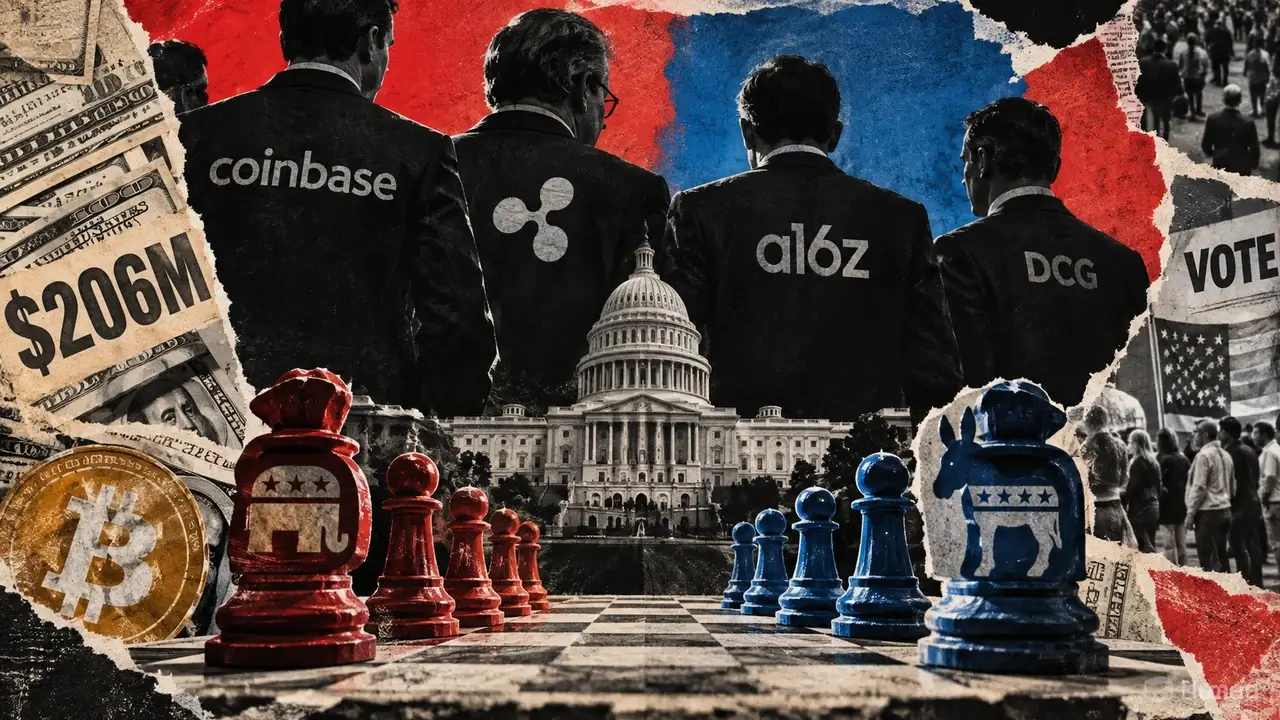
Crypto corporations contributed $206 million to super PACs and hybrid PACs through the second quarter of 2026, according to Public Citizen’s Aug. 27 analysis of FEC records.
That makes the industry the largest disclosed corporate donor sector tracked in this midterm cycle.
Yet that figure doesn’t capture how much of the amount has reached a campaign ad, and the industry’s political apparatus splits across several distinct organizations that each deserve separate accounting.
| Channel | Figure | What it measures | What it does not measure |
|---|---|---|---|
| Corporate contributions | $206M | Crypto corporate donations to super PACs and hybrid PACs through Q2 | Not ad spending |
| Fairshake-network independent expenditures | ~$70M | Spending tracked across 54 races | Not the entire crypto political operation |
| Stand With Crypto endorsements | 38 House candidates | Endorsement and voter-mobilization activity | Not PAC spending |
| Fellowship PAC independent expenditures | $4.45M | Separate PAC spending across 12 races | Not part of Fairshake’s total |
| Digital Freedom Fund independent expenditures | $0 | Reported candidate-facing ad spending | Not equal to its $22.4M in receipts |
Fairshake’s books tell a specific story
Fairshake, the central committee anchoring crypto’s political network, reported $137.9 million in receipts and $93.9 million in disbursements through Aug. 31, leaving $108.3 million in cash on hand.
The committee has also transferred $70 million to two affiliated PACs built along partisan lines. Defend American Jobs backs Republican candidates and has received $37 million in transfers. Protect Progress supports and opposes candidates in Democratic contests and has received $33 million, including a fresh $5 million transfer on Aug. 7.
That August transfer shows Fairshake continuing to fund its Democratic-facing affiliate into the second half of the cycle, while also funding its Republican-focused spending.
Coinbase has contributed $56.1 million to the Fairshake network, including a $23 million Bitcoin donation dated December 2024 that carried forward into this cycle. Ripple Labs has contributed $48.5 million, while Marc Andreessen and Ben Horowitz have added $24 million combined in personal contributions, and Digital Currency Group has added $1 million.
These donor totals cover a narrower network over a different time window than Public Citizen’s numbers, and the two should not be combined into a single sum.
The crypto spending splits unevenly by party
A September transaction tracker puts total Fairshake-network independent expenditures at about $70 million across 54 races, while separate FEC committee summaries put the same category closer to $71 million using a different reporting cutoff.
Within that spending, $32.5 million supported Republican candidates, $21.3 million supported Democratic candidates, $15.6 million opposed Democratic candidates, and the tracker shows no recorded spending opposing Republicans.
That pattern describes this network’s recorded activity, while other crypto-linked political organizations spend money entirely outside this dataset.
Alabama Senate candidate Barry Moore has drawn $12.2 million in support, and Kentucky’s Andy Barr has drawn $7.2 million. Illinois Senate candidate Juliana Stratton has drawn $9.7 million in opposition spending, spent once Fairshake worked against her in the Democratic primary.
| Spending direction | Amount | Share of ~$69.4M tracker universe |
|---|---|---|
| Supporting Republicans | $32.5M | ~47% |
| Supporting Democrats | $21.3M | ~31% |
| Opposing Democrats | $15.6M | ~22% |
| Opposing Republicans | $0 | 0% |
Stand With Crypto has endorsed 38 House candidates this cycle, six announced in March and 32 more on Aug. 24, and reports over three million advocates signed up through its platform.
That endorsement and voter-mobilization program operates independently of any PAC’s independent-expenditure ledger.
Fellowship PAC has raised $11 million, including $10 million from Cantor Fitzgerald, and has spent $4.45 million in independent expenditures across 12 races.
Sentinel Action Fund, backed partly by the Solana Policy Institute and Multicoin Capital, has supported Ohio Republican Jon Husted. It operates as one piece of a broader conservative political operation, whose overall funding base includes sources unrelated to crypto.
A $22 million crypto PAC with nothing spent
Digital Freedom Fund, backed heavily by Winklevoss Capital, reported $22.4 million in receipts and $22 million in disbursements through June 30. Its FEC summary lists $0 in independent expenditures and $381,746 in cash on hand for that same period.
Roughly $21.3 million of its spending went to Winklevoss Capital Fund LLC, the entity identified as the fund’s principal donor. A political committee can receive tens of millions of dollars and still show zero dollars deployed toward electing anyone, which is exactly the gap a headline fundraising number can hide.
Fairshake announced a new $30 million commitment on Sept. 21 to oppose Ohio Democrat Sherrod Brown. Its spokesperson confirmed the pledge and said more than $90 million remained available for the general election even after that commitment.
The announcement came six days after the Senate failed to advance the CLARITY Act on a 49-50 procedural vote, eleven short of the 60 needed. Unresolved disputes over ethics provisions and stablecoin-related banking issues had blocked the bill.
Whether the reserve gets deployed or stays banked
The bull case is that Fairshake and its affiliates spend down a large share of their remaining cash before November.
The CLARITY failure becomes justification for an aggressive final push that could push network-wide independent expenditures toward $160 million to $200 million. Under that path, crypto’s political operation becomes a genuine late-cycle force shaping close races nationwide, with Bitcoin and market-structure policy framed explicitly as stakes in specific contests.
| Scenario | What happens next | Estimated network IE range | Article takeaway |
|---|---|---|---|
| Bull case | Fairshake and affiliates spend down a large share of remaining cash before November | $160M–$200M | Crypto becomes a major late-cycle outside-spending force |
| Bear case | Ohio absorbs most incremental spending; more cash stays banked or shifts into non-candidate activity | $95M–$120M | Fundraising scale exceeds actual election deployment |
The bear case has Ohio absorbing most of the incremental spending while Digital Freedom Fund stays dormant. Additional cash sits in reserve as transfers, operating costs, or issue advocacy that never becomes a candidate-facing ad.
In that scenario, network independent expenditures stay closer to $95 million to $120 million. The defining story becomes a war chest that raised enormous sums while deploying only a fraction of it toward elections.
Crypto’s midterm operation has already proven it can raise nine-figure sums with ease. Whether it can turn that money into votes before Nov. 3 remains an open question the fundraising totals alone cannot answer.
The post Crypto firms put $206 million behind the midterms: here’s who their political machine is backing appeared first on CryptoSlate.