
CFTC staff presses exchanges on political speech prediction market bets, asks how to prevent manipulation
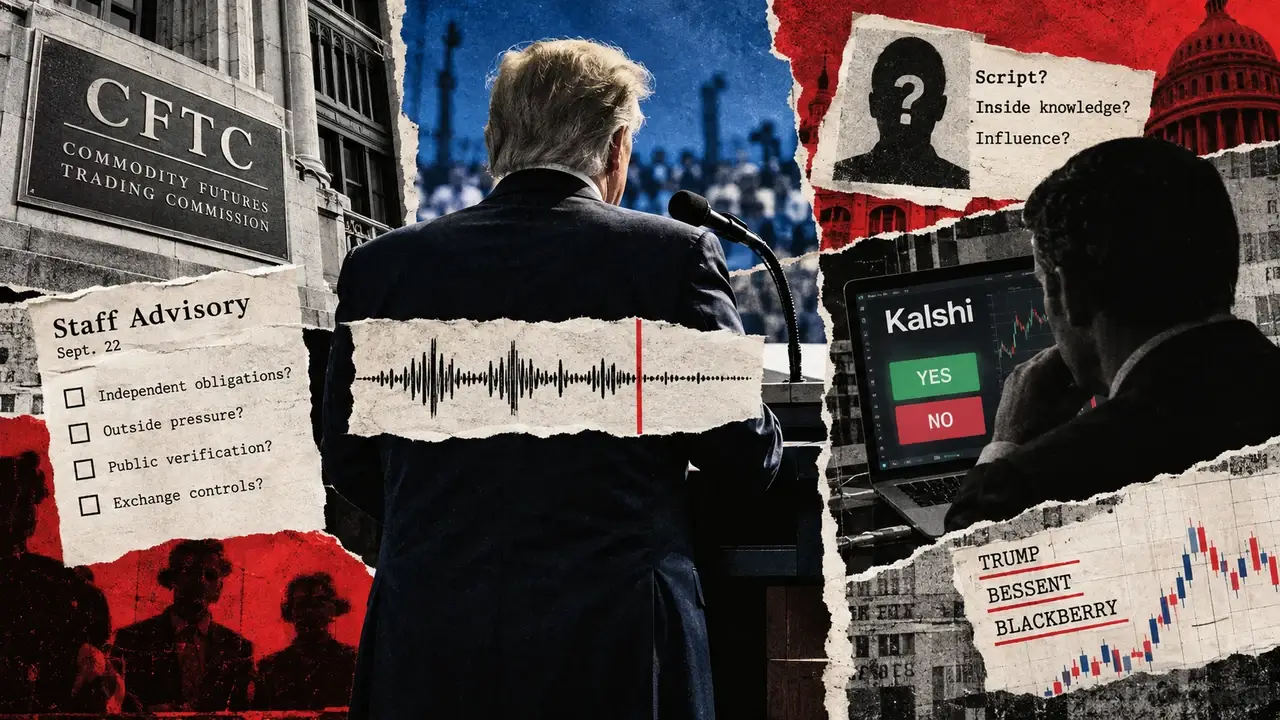
A clear video can settle whether a public figure said a particular word. It cannot show who knew the script beforehand or whether the speaker chose a word to affect a bet. That gap is at the center of a Sept. 22 advisory on speech markets from staff at the Commodity Futures Trading Commission.
The CFTC’s Division of Market Oversight says contracts tied to a named person’s words, appearance or interaction carry heightened manipulation risk. Staff may view them as presumptively “readily susceptible to manipulation,” a phrase drawn from the existing duty of regulated exchanges to list contracts that are not readily susceptible. The advisory asks for a stronger, contract-specific explanation of safeguards. It is a staff view, creates no binding rule and does not prohibit the category outright. Kalshi still listed speech markets the following day.
What exchanges must explain about speech markets
The staff advisory gives exchanges four non-exhaustive questions. Does the person who determines the outcome face independent legal, professional or other obligations that deter gaming it? Could someone pressure or induce that person? Can outsiders verify the result under substantial public scrutiny, and does the decisive word or act have any real significance in its setting? Are the exchange’s trading restrictions, surveillance and other controls suited to that particular risk?
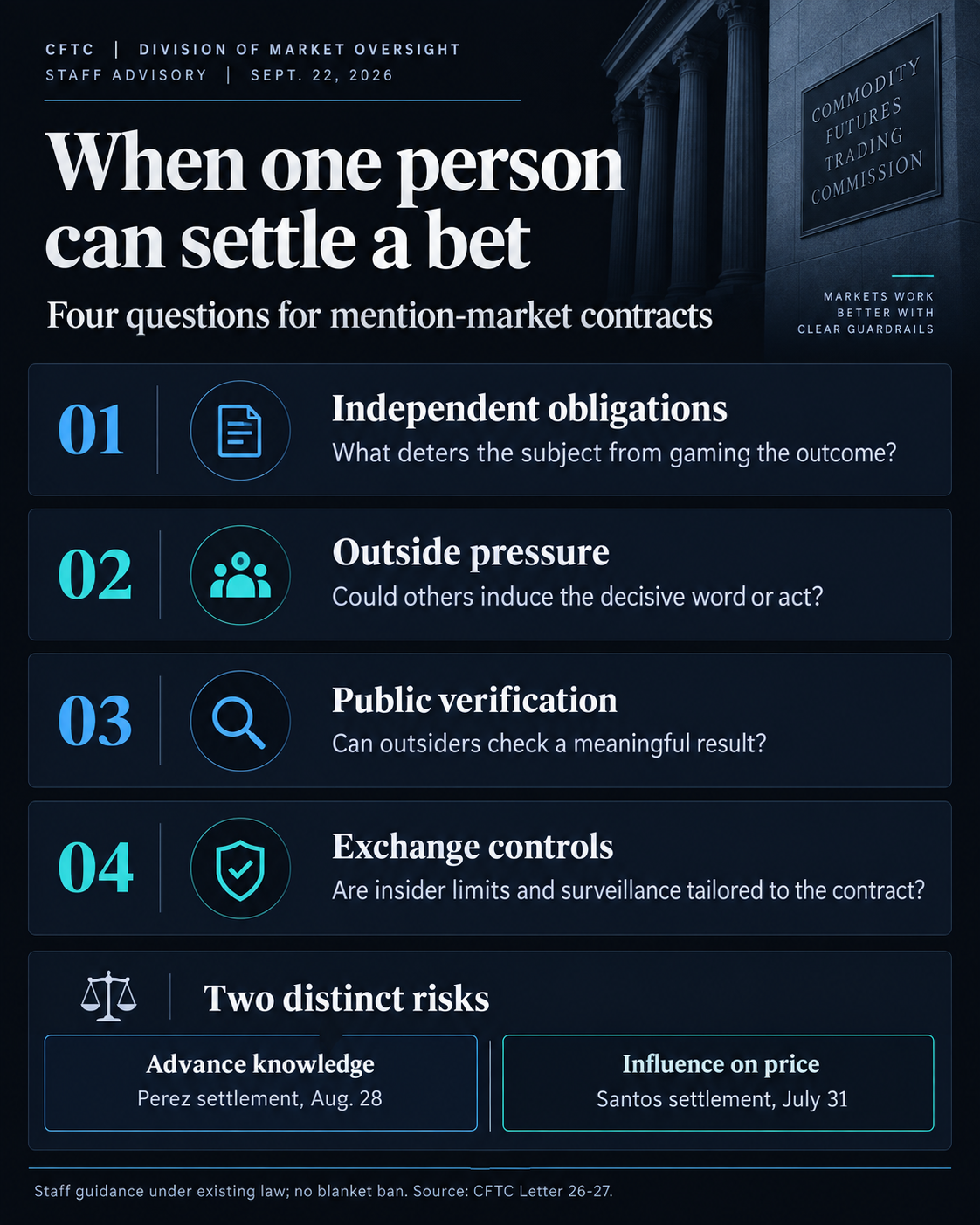
Public proof of what happened addresses only one part of the test. Staff says a speaker’s professional obligations cannot replace exchange controls. An exchange’s filing should explain its measures and how it identifies people who control an outcome or have privileged access.
A recent check of Kalshi’s mention markets covered Donald Trump’s remarks at Xi Jinping’s state arrival, Treasury Secretary Scott Bessent’s television interview and BlackBerry’s next earnings call. The three market pages displayed roughly $125,776, $5,333 and $23,973 in volume, respectively, during Sept. 23 checks. The figures change as trading continues.
The Trump contract offered a bet on whether he would say “China” at least five times. Its published rules use a live video or stream of the Sept. 24 ceremony to determine the outcome, turning to official transcripts if Kalshi employees cannot reach a consensus from video. Only Trump’s speech in an official capacity counts. The page also bars employees of source agencies and anyone holding material nonpublic information about the event from trading.
Those terms provide a way to check what was said in public and state who should not trade. They do not, by themselves, establish how an exchange would detect a script holder trading through another account or pressure on a speaker to say an incidental word. The Bessent and BlackBerry listings show the test reaches government interviews and corporate calls as well as presidential remarks. The visible listings alone cannot show how surveillance is tailored to each event.
Kalshi says it screens certain political figures and relevant government employees, restricts trading by people with inside information or influence over outcomes, and monitors trading patterns. It says flagged accounts can be frozen and cases referred to regulators. Those are Kalshi’s stated controls, not an independent assessment of how they work for these three contracts. Spokesperson Elisabeth Diana told RotoWire on Sept. 23, “We’ve addressed this guidance based on a prior discussion with the CFTC.” She did not specify changes to the sampled markets.
Knowing the result is different from changing it
The CFTC’s August settlement with Gabriel Perez shows the advance-information problem. The agency’s order found that the White House teleprompter operator used access to presidential speeches before delivery to trade mention contracts between December 2025 and February 2026, earning $107,539. Its account does not say he changed the words. His advantage came from knowing more than other traders before the speech.
A separate July settlement illustrates a different danger. The CFTC found that former Rep. George Santos traded a contract on his own State of the Union attendance while posting misleading statements about his plans. Prices moved in his favor. The subject’s ability to control attendance and influence what others believed about it was the problem there.
Neither settlement establishes misconduct in the three contracts. For speech markets, the advisory’s question for exchanges is whether each contract’s verification, insider restrictions and surveillance address both the person who can choose the result and those who may know it first. Until that is clear, a price on an optional word deserves caution as an independent forecast.
The post CFTC staff presses exchanges on political speech prediction market bets, asks how to prevent manipulation appeared first on CryptoSlate.